



The power of being present.
Highlights:
- Ramsdell’s career has been guided by two simple criteria: the science must genuinely fascinate him, and it must have the potential to improve people’s lives.
- By studying Scurfy mice, they identified FOXP3 as a crucial regulator of the immune system and later connected mutations in the same gene to the human autoimmune disorder IPEX.
- Understanding FOXP3 and regulatory T cells opened the door to therapies designed to control excessive immune responses, with potential applications in rheumatoid arthritis, multiple sclerosis, type 1 diabetes, Crohn’s disease, and other autoimmune conditions.
- Ramsdell credits mentors, colleagues, friends, and family throughout his journey. One of his central lessons is that success means “being good at what you do and, at the same time, being a good person.”
- For Fred, meaningful work and relationships require paying attention to where you are and who you are with now.
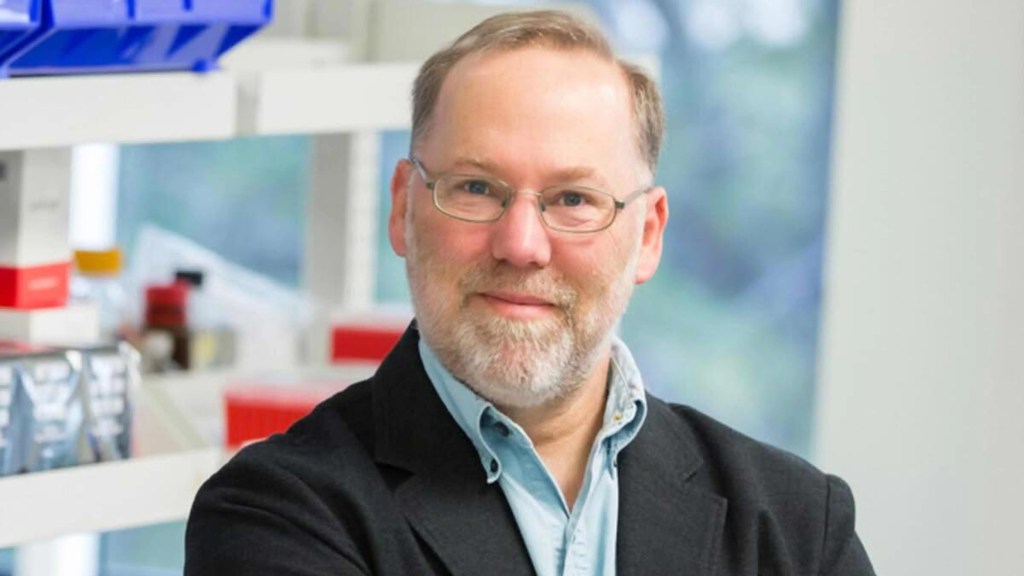
In an old building in Stockholm’s historic center, in the medieval heart of the city, the Nobel Prize Museum preserves a pair of clearly well-worn low-cut boots that belonged to immunologist Frederick Jay Ramsdell. He was wearing them while hiking in an area of Idaho with no cell service, as people tried to reach him to tell him that he had won the 2025 Nobel Prize in Physiology or Medicine, together with Dr. Mary E. Brunkow and Dr. Shimon Sakaguchi, “for their discoveries concerning peripheral immune tolerance.”
“I always liked science,” says Dr. Ramsdell, “but I didn’t think I would become a scientist until I got to college.” In fact, he spent his first semester studying theater, thinking he might become an actor. He quickly realized that not being able to dance or sing closed quite a few doors for him as an actor. So he changed course and turned to science.
In that class, I realized that the immune system was involved in, if not responsible for, virtually every disease known to humankind.
Frederick Jay Ramsdell
To pay for his education, he took whatever jobs he could find. “I was a cook in a restaurant. One summer I worked on a plastics assembly line. I did landscaping. I assembled integrated circuits,” he recalls. In 1981, he transferred to the University of California, San Diego. There, he took a class with Dr. Dick Dutton, a renowned immunologist. It was then that he discovered he wanted to dedicate himself to the field. “In that class, I realized that the immune system was involved in, if not responsible for, virtually every disease known to humankind.”
In 1983, while pursuing his doctorate in Microbiology and Immunology, he conducted research under the mentorship of Dr. Golub at the University of California, Los Angeles School of Medicine. “There were always people around me who looked after me and supported me,” he says. During graduate school, he shared an apartment with his best friend, for whom he would later even serve as best man at his wedding. “I think there were several days a week when the only reason I ate was because he bought me food,” he recalls. So, emotionally, psychologically, and financially, his friend was an enormous source of support. “My girlfriend, who is now my wife, was also incredibly supportive,” he says.
So why don’t they attack them?
Frederick Jay Ramsdell
During the 1980s, the scientific community succeeded in identifying and understanding the T-cell receptor. Scientists knew that T cells were an important part of the immune system because they could recognize virtually anything, from viruses and bacteria to many other substances. “That means they can also recognize us,” Ramsdell explains. They can recognize our own kidneys, our own liver, and our own heart. “So why don’t they attack them?” he wondered. He believed that if they could understand how that system worked, “we could find opportunities, identify new therapeutic targets, and perhaps use that information to develop drugs that would help the 10% of people who develop autoimmune diseases.”
That question led him to study a type of laboratory mouse known as Scurfy. Their coats are rough, their appearance hunched and sickly, and they develop severe skin lesions. “They seemed to have every autoimmune disease known,” he says. In addition to psoriasis, they had diabetes. They had Crohn’s disease. They had myositis. They had everything. “They died at three weeks of age from massive autoimmunity,” he explains. Their immune systems had completely lost the ability to distinguish between self and foreign. Instead of protecting the body, they attacked virtually all of its tissues. Researchers knew that the problem was related to T cells, but they did not understand exactly what had gone wrong.
That was the origin of his discovery. All they had was what they could observe in the mouse. In genetics, that set of visible characteristics is known as a phenotype. The phenotype was that of an animal with an immune system completely out of control. “What gene was defective in that animal to produce that phenomenon?” they wondered. The answer was a previously unknown gene, which they called FOXP3, that acts as a regulator of the immune system. That discovery led them to ask whether the same mechanism also existed in humans.
“One of my colleagues was in contact with researchers at the University of Washington and Oregon Health Sciences who were pediatric rheumatologists,” he says, describing the process of connecting their discovery to human disease. They treated children with rheumatologic diseases and knew that both groups had identified families in which approximately half of the children died within the first few years of life from a disease called IPEX, which, “in essence, is the same disease that we were seeing in these Scurfy mice.” It is a disorder characterized by uncontrolled immune-system activity. “We simply sequenced the FOXP3 gene in those families, and it turned out that in both of those independent families, as well as several others with this disease, they all had mutations in the same gene,” he says. At that moment, they knew that the gene controlled this process in humans as well.
Our company is working on rheumatoid arthritis and another disease called hidradenitis suppurativa
Frederick Jay Ramsdell
Regulatory T cells in the immune system help prevent the body’s defenses from overreacting and, above all, keep them from mistakenly attacking the body’s own tissues. To function properly, these cells depend on the FOXP3 gene. Thanks to this discovery, therapies using these cells are now being developed, in which they are modified in the laboratory and then reintroduced into the patient. Today, many research groups are investigating ways to make them more powerful in people living with autoimmune diseases. Sonoma Biotherapeutics, a company Ramsdell helped found, is working to develop therapies for autoimmune and inflammatory diseases. “Our company is working on rheumatoid arthritis and another disease called hidradenitis suppurativa,” he says. Other companies and academic groups are developing this strategy for graft-versus-host disease, multiple sclerosis, type 1 diabetes mellitus and, soon, Crohn’s disease.
What makes all of this meaningful to me is the possibility of treating patients who don’t have many other options left
Frederick Jay Ramsdell
These advances are already beginning to make a difference in the lives of some patients. Some have told him that they can finally open a jar again, something they had been unable to do for years. “What makes all of this meaningful to me is the possibility of treating patients who don’t have many other options left,” he says. At its core, that idea captures the way he understands his work, which has always been guided by two principles. The first is that what he does has to be interesting. “I can’t define exactly what ‘interesting’ means, but it has to be interesting to me.” And, beyond that, it has to have the potential to be useful.
For Ramsdell, those principles also mean recognizing that science is never an individual endeavor. He has had the good fortune to work with biochemists and molecular biologists who are among the best in the world. That allows you to move faster and do better work. You work as part of a team: “Being good at what you do and, at the same time, being a good person. To me, that is real success.”
In that sense, science has allowed him to build a network of friends whom he considers part of his family. “The Nobel Prize, in some ways, made that even more apparent to me,” he recalls. For him, having that community is a fundamental part of life. And taking care of it, he says, requires paying attention: “Be present in the moment.” Sometimes that means putting away your phone, which only distracts you from where you are. It also means letting go of the person who upset you yesterday and not spending so much time thinking about what you will do tomorrow while you are still living today. Just as, while people in Stockholm were trying to reach him to tell him that he had just won the Nobel Prize, he was simply where he was.


